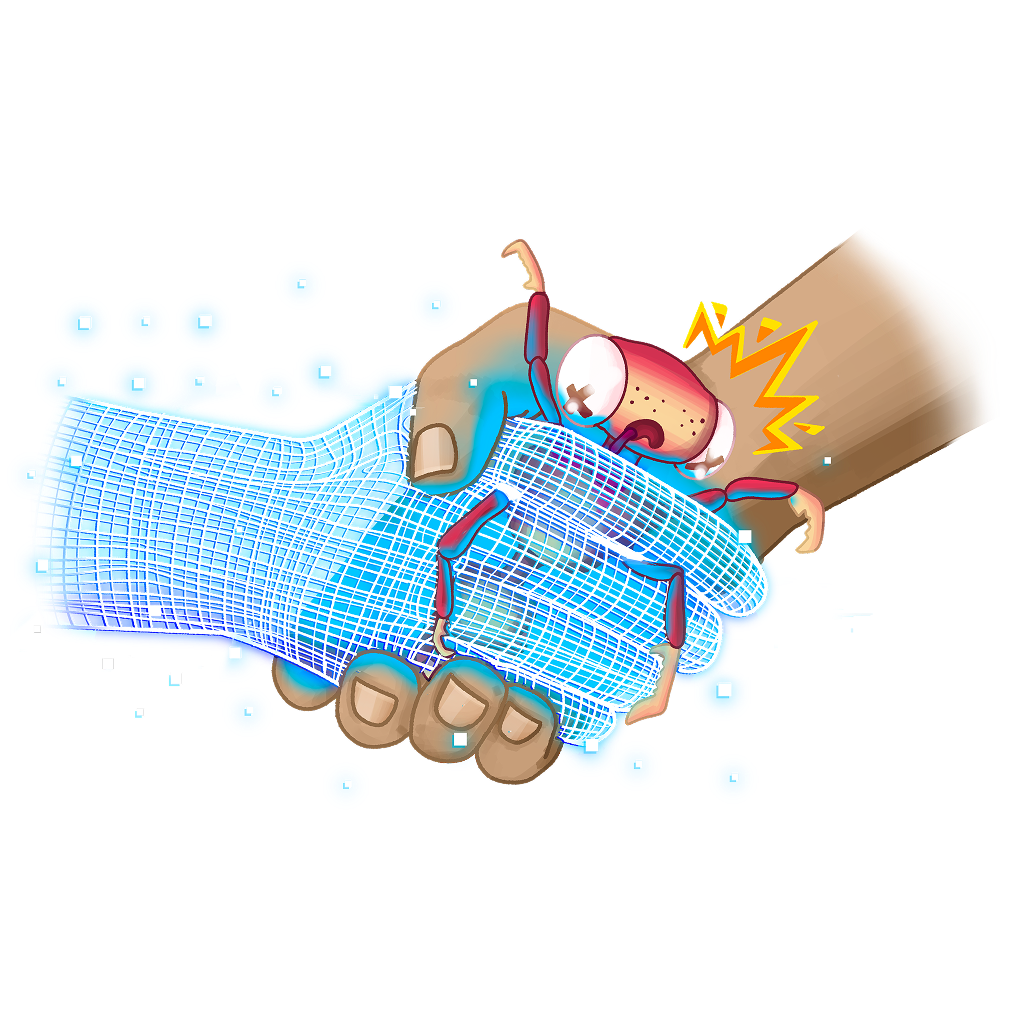
Human ingenuity fuels security research. AI makes it more necessary
AI is changing how software is built, tested and attacked. Your security model now has to account for new behaviors, new classes of vulnerabilities, and a much faster pace of discovery.
Crowdsourced security at AI speed: a real-world view
AI is accelerating the development lifecycle while increasing the volume, complexity, and pace of security work. The challenge is not only finding more vulnerabilities, but finding the right ones, validating them quickly and understanding their impact.

Development is moving faster
84% of Stack Overflow Developer Survey respondents are already using or planning to use AI tools in their development process, with 51% of professional developers using them daily. More AI-assisted development means more code, more change and more surface area to secure.

Human verification still matters
Despite the increase in AI tool usage among developers, 46% distrust AI output accuracy, compared with 33% who trust it. AI can accelerate work, but accountable teams still need human judgment over what gets shipped and secured.

The scope has evolved
OWASP’s Top 10 for LLMs and GenAI Apps highlights risks such as prompt injection, sensitive information disclosure, supply chain weaknesses, data and model poisoning, excessive agency, system prompt leakage, vector and embedding weaknesses, and misinformation.
If this sounds familiar…

Your backlog was already full. AI increased code volume, release speed and vulnerability submissions.

More findings do not always mean more vulnerabilities. Duplicates, unclear reproduction steps and low-context reports still need expert triage.

AI features have introduced new failure modes: prompt injection, unsafe tool use, RAG poisoning, jailbreaks, data leakage and harmful outputs.

AI systems change fast, with model updates, prompt changes, new tools, and new retrieval sources. Continuous testing helps you keep pace as the risk surface evolves.

Your team needs support to cut through the noise with evidence that satisfies engineering, security and governance stakeholders.


Book an AI security scoping call
Start the conversation today. Our experts will help map your AI surface, identify priority risks, and recommend the right testing program for your team.












Two AI journeys. One need for human-guided security testing

For teams using AI to build faster
AI can help engineers write code, explore unfamiliar systems, generate tests, and move through delivery cycles faster. But faster delivery changes the security equation.
More automation means more assumptions.
More code means more paths to review.
More AI-assisted vulnerability discovery means more findings reaching your team.
Intigriti helps you turn higher volume into validated findings through managed triage, clear scope design, and human-in-the-loop review.

For teams building AI into products
AI features introduce risks that traditional AppSec testing was not designed to handle.
A customer-facing assistant may expose sensitive data.
A RAG system may retrieve poisoned or over-permissioned content.
An agent may invoke tools, change state or act across workflows.
A model may produce harmful or misleading output even when no traditional vulnerability exists.
Intigriti helps you test both the security of the AI system and the safety of its behavior.
AI can accelerate security work. It cannot replace human judgment.
AI can scan, summarize, generate, and accelerate. It can help researchers move faster,
and it can help security teams process more context.
But the findings that matter most still depend on human creativity:
business logic abuse, chained attacks across systems, contextual safety failures,
novel misuse cases and the ability to explain why a finding matters.

The best hackers do not fear AI, they use it. AI makes their work faster and sharper, but it does not replace the hacker.
Stijn Jans
CEO
Secure the system. Challenge the behavior.
AI security and AI safety are connected, but they are not the same problem.
AI Security
AI security protects the system from unauthorized access, manipulation, or abuse.
These findings often look like traditional vulnerabilities: a tool that can be called against another user’s account, a system prompt that leaks privileged content, or a RAG corpus that can be poisoned to influence retrieval.
AI security findings can often be scored with CVSS because the impact is technical.
AI Safety
AI safety focuses on whether the model can be pushed into producing harmful, misleading, or unacceptable output.
The impact is contextual. A harmful response from a child’s product, a financial assistant or an internal developer tool carries very different levels of business, brand, and regulatory risk.
That is why AI safety needs a severity model designed around your product, your users and your worst-case outcomes.
The highest-value findings often combine both
A safety bypass may enable a tool call. A leaked system prompt may support data access. A manipulated retrieval path may cause the model to act on the wrong information.
Intigriti helps you design a hybrid program that can identify, score and prioritize security findings, safety findings and chained findings across both.


A tailored program, not a generic AI checklist

Custom AI scope
We help map the AI systems, prompts, tools, agents, RAG sources, guardrails, and downstream workflows that need to be tested.

Worst-case outcome mapping
We work with your team to define what really matters: customer harm, data exposure, regulatory impact, brand damage, unsafe automation, or misuse of connected tools.

Hybrid severity model
We combine CVSS-based scoring for AI security findings with a custom safety severity table for AI safety findings, plus clear logic for chained findings.

Specialist researcher engagement
We help engage researchers with relevant experience across prompt injection, agent abuse, RAG attacks, safeguard bypasses, output handling and AI-assisted vulnerability discovery.
AI-fluent triage
Our triage process is built to validate evidence, reduce noise and keep humans responsible for judgment-heavy decisions.

Continuous calibration
AI systems change quickly. Your testing program should evolve as models, prompts, tools, retrieval sources and product behaviors change.
Choose the testing model that fits your security maturity
AI Security & Safety Bug Bounty
For teams that need continuous testing of AI systems, features or workflows. We help you scope the program, define rewards, engage the right researchers and manage triage over time.


Focused AI Security Testing
For a specific launch, model update, agent workflow or high-risk product area. Use focused testing to generate deeper assurance around a defined AI surface before it reaches more users.

Managed VDP with AI scope
For teams that want a safe, structured way for researchers to report AI-related vulnerabilities, unsafe behaviors or integration risks without running a full bounty program immediately.
Live hacking for AI launches
For high-priority releases that need concentrated researcher attention, real-time collaboration and a competitive environment focused on business-critical AI risks.
How it works
Whether you are running Bug Bounty, a VDP, or PTaaS, here is how we design every AI security and safety program we run.

Scope your AI surface
We work with your security, engineering, and product teams to understand how AI is used, what it can access and where risk could emerge.

Define what matters
Together, we map your worst-case outcomes and define the safety, security, and business risks your program should prioritize.

Design the right program
We shape the scope, evidence requirements, reward model, researcher access, safety categories and reporting approach around your goals.

Launch, learn and recalibrate
We help engage the right researchers, validate findings through managed triage and refine the program as your AI systems evolve.
AI is increasing speed and volume. Quality still needs human judgment
From 2022 to 2025, vulnerability submissions on Intigriti grew by 328%. New researchers are also producing more submissions in their first 30 days, while validity ratios have remained broadly consistent since the start of 2025. The conclusion is not that AI is breaking bug bounty. It is increasing throughput.
For security teams, that creates a new operational reality: more total findings, more noise in absolute terms and more need for strong triage, clear scope and human-led prioritisation.
Intigriti helps teams keep pace without losing the judgment that complex security work requires.
We don’t optimize for speed alone. We optimize for outcomes.
Stijn Jans
CEOContinue learning with our AI insights

Securing the uncharted territories of AI systems. A discussion with Leo Racanelli
The intersection of AI and cybersecurity is reshaping how we find, fix, and think about vulnerabilities. Yet for all the headlines...

CEO insights: holding on to the human line in the age of AI adoption
Humans and AI working together can deliver extraordinary results, but only when the right intelligence is applied in the right way...

Common AI misconceptions debugged!
How AI is boosting researcher productivity How new researchers are approaching bug bounties Why the quality of submissions is not declining How effective...
Build faster with AI. Secure smarter with people
Book a call with us to discuss what a program built around your specific needs could look like in practice.
The incredible triage team at lntigriti may not be listed as a feature, but they are certainly our favorite aspect. Numerous times, after assessing a researcher's submission, I've turned to the internal chat with a question, only to discover that the team had already proactively addressed my concerns without me even asking.


Sándor Incze
CISO